

Taming Your Attention Dragon
How To Reclaim Your Attention, So You Can Lead With Intention


There is a dragon that lives in my neck. Its physical manifestation is a trapped nerve that howls with searing pain when it’s moved the wrong way. This week I worked with my physiotherapist, and with one movement of my neck, the dragon spewed fire like it never had before. The pain was so intense. My physio asked me to relax. I said, “I can’t. I’m so scared of the pain.”
I didn’t feel safe and I was anticipating pain. How could I relax? My attention was 100% focused on preventing a movement that would cause more pain. My anxiety helps restrict my movements and anticipate what will cause pain, which keeps the dragon calm. Anxiety is very helpful in that way; the downside is that it eats a lot of attention. My focus is on preventing the pain, which makes it hard to focus, much less to do new, exciting things.
It’s the new year and many of us want to be more intentional with how we spend our time this year. I’ve seen dozens of these “intention + attention” lists:
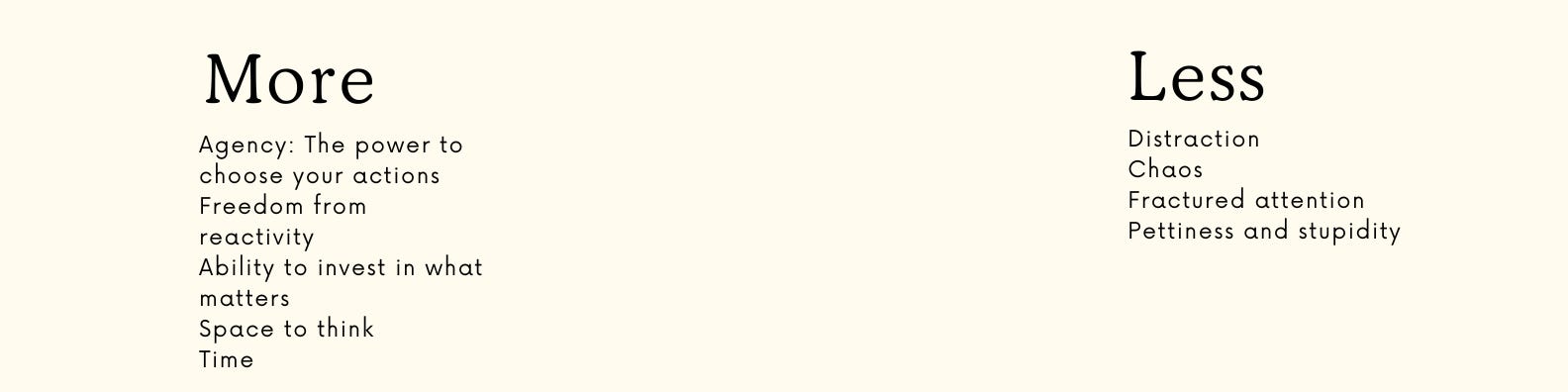
But in order to be intentional, we have to free up our attention. There are so many things that demand our attention, but the biggest one is something that occurs unconsciously for many of us. Yes, we should all cut our social media use and make more time for deep work. But unless we unlock the emotional layer draining our attention, all that will be useless. And the hidden layer is anxiety. Not anxiety like an anxiety disorder— but rather the layer of protection we’ve all created for ourselves to keep operating in the world, to keep being who we are, to maintain our status and livelihood, and to feel safe. It’s the part of us that’s in the “what if” posture. And we don’t even notice it most of the time.
This is how many of us operate right now: in the space of “What If.” And it eats our attention. If we don’t fear pain, we fear loss, or chaos, or disappointment, or even worse. Maybe we don’t even know what we fear, it’s just the way things are (more on this below). We are so focused on preventing the pain that our attention is largely taken up by it. I don’t have to tell you that when you’re focused on preventing something, it’s hard to be expansive or innovative, or open to change.
If you’ve ever tried to change a behavior—stop micromanaging, delegate more, rest, think strategically, be more present—and found yourself unable to do it even though you wanted to, you’ve brushed up against what Robert Kegan and Lisa Lahey call “Immunity to Change.”
Our anxiety is like our immune system: It protects us from hurt. Sometimes it’s protecting us from physical pain, like the dragon in my neck. More often, it’s protecting us from something less visible but just as powerful: loss of status, loss of control, loss of belonging, or the fear of being exposed as not good enough. But immune systems can also get overactive, and they can harm us, too.
What lies underneath the surface is anxiety, which, Kegan and Lahey explain, they have come to appreciate as ‘the most important—and least understood—private emotion in public life’:
Most of us think of anxiety as panic attacks or stage fright, acute episodes brought on by a big presentation to the boss or some other high-stakes occasion. Or a condition specific to people who were traumatized as children or survived some harrowing event. But Kegan and Lahey see anxiety as our brain’s background noise, revving up when we’re confronted with something new, unfamiliar, or threatening, and operating most of the time at such a low volume that we don’t even hear it. ‘We all have anxiety, just by virtue of being human,’ Lahey says.
We don’t think of ourselves as continually fearful, Kegan says, because we’ve figured out how to manage this undercurrent of anxiety—whether it’s our discomfort at meeting new people, our worry when talking to the boss, or our indecision in the jam aisle of the supermarket. ‘For instance, I may have a deep-running anxiety that you don’t think well enough of me,’ says Kegan. ‘But I don’t live my life every day like I’m walking on eggshells, because I’m very tuned in to what you want or need in order to continue to have a high opinion of me. I use my energy to make sure that I keep delivering what I believe it is that you want. As a result, I don’t feel the anxiety because I’m handling it.’
Kegan and Lahey ask us: What would happen if we stopped the behavior that gets in the way of achieving the goals we’ve set for ourselves? We would have much more attention. We could work with intention. The More/Less list above would resolve. Kagan and Lahey want us to understand our anxiety “in the context of the “big assumptions” that underlies it— ideas we take for granted about the way the world works and our place in it. Our parents convey to us their understanding of life, Kegan and Lahey explain, and we often take their opinions as fact. For one CEO they feature in their book Immunity to Change, the belief that needed to be challenged was: “If I want something done right, I have to do it myself.” Other examples could include assumptions like “If I say no, I’ll lose people’s friendship and respect.” These beliefs, Kagan and Lahey call, “The Way Things Are.” In my experience working so hard to maintain the way things are demands a lot of our attention, especially in times of stress and uncertainty. It can be challenging to act with intention when your attention is hijacked by protecting the way things are.
So what do we do? I believe it starts with reclaiming attention. You can call this mindfulness, you can call this tuning in. But freeing up attention so we can act with intention starts with tuning in, and taking your attention off auto-pilot.
But How Do You Reclaim Attention?
Science tells us that the recipe for reclaiming attention is mindfulness, curiosity, and self-compassion. It has certainly worked for me. Attention is a finite, precious resource, and right now, most of it is being quietly siphoned away by complexity, stress, overwhelm, and anxiety. Think about what runs through your mind on a typical day:
How did I do in that meeting?
Did people like my idea? I hope so.
Ugh, but I’m sure my idea will get killed once it reaches the SVP.
Will I earn enough money?
Am I a good leader?
Do people still respect me after I said that dumb thing?
Does Ron want my job?
The board meeting is next week. I have so much to prep…. But when?
Am I a good parent?
Oh crap, I forgot to call the dentist.
Oh sh**, I forgot to answer that email.
Did that email sound passive aggressive? I’d better re-read.
Is AI going to take my job?
Another re-org? Here we go again…
You get the point. Our brains evolved to ask this central question: Am I safe? Chronic uncertainty keeps our nervous systems on high alert. We’re triggered a million times a day, often without realizing it. As Dr. Angela Neal Barnett put it in one of my favorite quotes ever, “work is school for grown-ups,” with all the same dynamics of approval, shame, comparison, and belonging, just with higher stakes. Triggering is what causes a lot of the reactivity we all experience at work, and which frustrates us greatly.
Mindfulness
If I could wish one thing for you this year, it would be to reclaim your attention by being more mindful. Not in a vague, aspirational way but in a practical, embodied way. Notice how you feel throughout the day. Listen to your body. Pay attention to where you tense up, shut down, rush, avoid, or over-control. Notice your thoughts without immediately believing them.
Anxiety hijacks attention by design. When the brain perceives threat, it:
Narrows focus
Scans for risk
Replays worst-case scenarios
That process consumes enormous cognitive bandwidth. Mindfulness interrupts this by:
Helping you notice anxiety sensations early (tight chest, racing thoughts)
Allowing the nervous system to downshift
Allowing you to practice noticing so you can take a beat and respond, not just reflexively react
Studies show mindfulness reduces activity in the brain’s default mode network—the system associated with self-referential thinking and mental chatter—freeing attention for the task at hand. In the simplest terms, it brings you to the present moment. For more on why mindful leaders are so effective, listen to my interview with Ravi S. Kudesia. (In fact, the Anxious Achiever archive is loaded with episodes on the power of mindfulness. Just do some Googling.)
Curiosity
And then, try to get curious. Instead of ignoring ask: What is my anxiety trying to tell me?
Why does her name in my inbox make me feel nauseous?
Wow, my jaw is tight. I wonder why?
Why am I avoiding this employee?
Why does this meeting feel so loaded?
Why do I seem unable to complete this project?
Why do I keep talking over everyone in meetings? Can I pinpoint what I am feeling when I do this?
Often, anxiety is pointing to something important: a lack of clarity, a fear of failure, a fear of being disliked or exposed, unresolved hurt, or something we deeply care about and don’t want to lose. Anxiety isn’t the enemy; it’s information. The question then becomes: Is anxiety serving me right now? And if not: Is there a different choice I can make?
We can’t control anxiety. We can’t cure it. But we can choose how we respond to it. Is this something you can practice in 2026?
Self-compassion
If you’re an anxious achiever, this choice will be made possible by self-compassion (read more about the science of self-compassion here.)
At high levels of performance, we are often our own worst enemies. We push, judge, catastrophize, and self-criticize in the name of excellence. Self-compassion isn’t indulgent; it creates flexibility, and it helps us practice tuning in. When your brain reverts to the anxious behaviors that protect The Way Things Are, it may be flavored with a dose of self-criticism. After all, surely you’re doing something wrong to feel this way. At some level, maybe it’s all your fault. Self-compassion tells the critic to take a back seat so that we can focus on the work at hand, and it starts with being less critical about your own anxiety. :-) Sometimes the most helpful move is simply to talk to your anxiety: “Hello, friend. What’s going on here?”
When we reclaim attention, we reclaim intention. We gain freedom from reactivity. We gain the power to choose our actions. We gain the ability to invest in what truly matters—our people, our values, our communities, and our joy. This is my goal for 2026. Join me?
With Feeling,
Morra
P.S.: Happy New Year!
P.P.S.: Want more on self-compassion? Listen to my interview with Dr. Kristin Neff here.